
Medford City Directory Sources
Southern Oregon History, Revised provides Medford’s main digitized directory spine. It lists Jackson County Directories from 1863 through 1932, separate Medford Business Directories from 1884 through 1932, historical Medford voter lists, and indexes. Those labels describe collections with different scope, not one unbroken annual list of every resident. Read the title page and the year before deciding what a particular volume can establish.
| Collection | Years | Publisher or form | Where held | Access |
|---|---|---|---|---|
| Jackson County Directories | 1863–1932 | County and Rogue Valley directory material | Southern Oregon History web project | Free online collection route |
| Medford Business Directories | 1884–1932 | Polk’s business and gazetteer materials | Southern Oregon History | Free online collection route |
| Jackson County Directory | 1916 | H. W. Rothermel and J. B. Fee; Medford Printing Co. | Southern Oregon History transcription and authorized scans | Online text, then scan or original where needed |
| Polk’s Directory | 1912 | Polk’s volume | Southern Oregon History and scan access | Use the transcription with the original page |
| Historical Medford voter lists | Dated City election lists | Historical voter-list material | Southern Oregon History | Historical presence only |
Gaps and changes in scope matter. A business directory is not a universal household directory, and a historical voter list is not continuous proof of residence. The collection titles provide the first boundary check before a name or address is carried into another source.
The Southern Oregon History collection gathers the local directory, voter-list, and index routes in one starting place.
Use the collection’s stated year and document type as part of every research note.
The 1916 Medford Directory Scope
The 1916 Jackson County Directory calls itself an Official Directory of the City of Medford within a larger countywide volume. Its alphabetical material covers Medford citizens, firms, and professional entries, but the volume also reaches Ashland, Central Point, Eagle Point, Gold Hill, Jacksonville, Rogue River, Talent, other towns, villages, and rural or free-delivery routes. That broader scope is a useful warning against reading a countywide hit as a Medford-only claim.
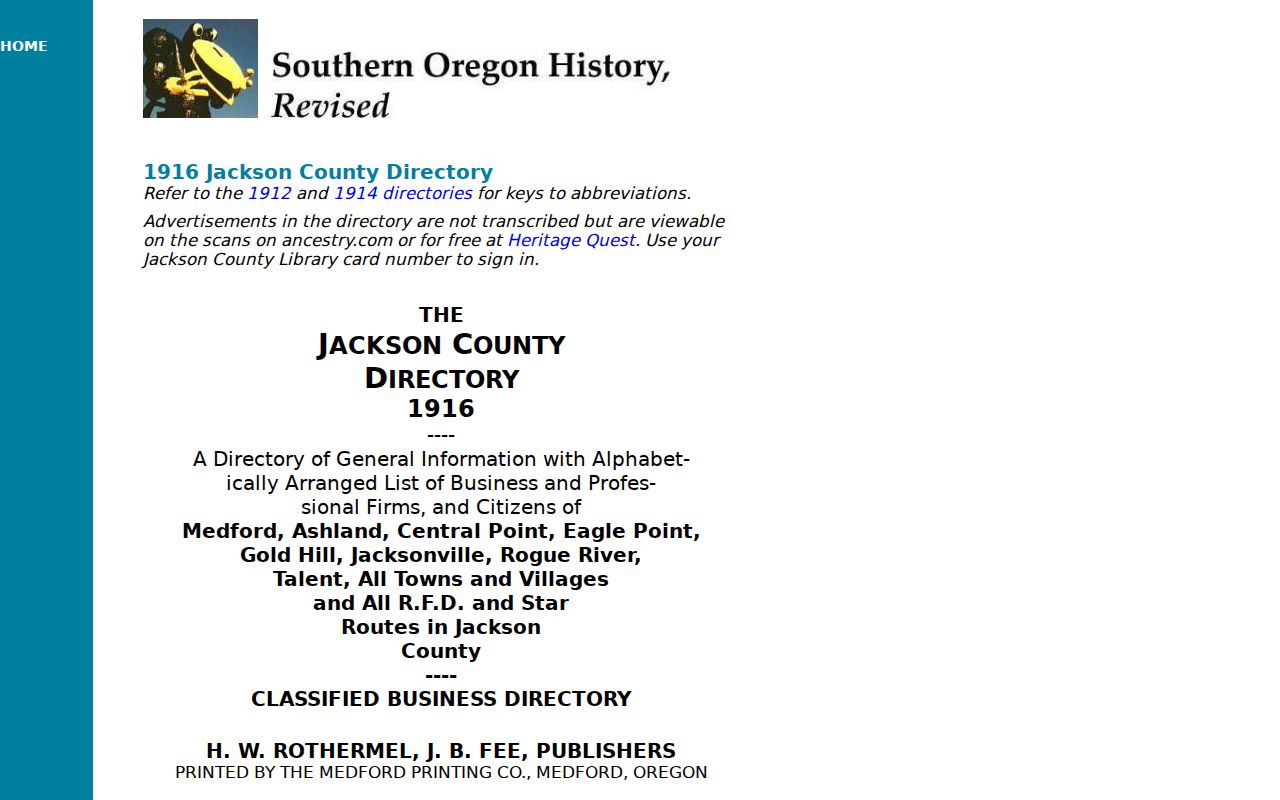
The digitized introductory material identifies H. W. Rothermel and J. B. Fee as publishers and Medford Printing Co. as printer. It also directs readers to the 1912 and 1914 volumes for abbreviation keys. Advertisements were not transcribed, although the source notes that scans are available through library-authorized services. Start with searchable text, then inspect the scan or original when the full printed page matters.
The 1916 directory page shows the local title and introductory information.
The city directory is strongest when its stated scope, page, and year remain attached to the result.
Reading a Medford City Directory
A local city directory entry may offer more than a name, but fields vary by volume and section. The 1916 source supports alphabetically arranged citizens, firms, and professional entries. A line may carry initials, a spouse or widow clue, an occupation or organization notation, and an address. Read the entry alongside that year’s key rather than assuming every line includes the same facts or that a transcription captured every printed mark.
| Name or initials | Record the spelling exactly, including initials and a possible name variant. |
|---|---|
| Spouse or widow clue | A relationship notation can be a family-history lead, but it needs a second source for confirmation. |
| Occupation or organization | Some entries add a trade, firm, or other local association; the year’s format controls. |
| Address | A dated address is a location clue, not a deed ownership statement. |
| Abbreviation | Use the volume’s key before expanding a shortened word or mark. |
- Criss-cross section
- An address-ordered portion of a directory when that specific volume supplies one. Do not assume every Medford volume has it.
- Householder index
- A volume-specific index that groups listings by a household heading when the publisher chose to include one.
- Abbreviation key
- The volume’s guide to shortened terms and marks. The 1916 source points readers to 1912 and 1914 keys.
The field inventory is deliberately cautious. It helps preserve the difference between what a printed line says and what a later researcher infers from it.
Medford Directory Spelling Checks
The 1912 Polk’s transcription warns that even corrected text can retain suspect spellings and that a search may not find every name. Try surname variants, initials, and nearby alphabetical entries. Then inspect the scan or original and the abbreviation key. This is more reliable than treating a failed text search as proof that a person, firm, or address never appeared.
A changing street form needs the same care. A person can be absent because the volume’s geographic scope changed, a spelling changed, or the relevant item is only visible in an untranscribed scan. Keep the directory year and source page with the search terms used.
JCLS Medford Directory Card Index
JCLS Local Research offers a different kind of historical directory lead. The Medford Local History Index is a physical card file near the reference shelves, not an online database. It indexes people, places, and events in local books, magazines, and newspapers. Each card points to source and page codes, so a reference librarian can help translate the code and retrieve the underlying item.
JCLS Medford is at 205 S Central. Its four digital microfilm readers can save images to a flash drive or email, and prints cost 10 cents per page. Contact the Reference Desk at 541-774-8689 or information@jcls.org to identify the local-history, newspaper, or microfilm format before assuming that a city directory title is online.
Note: A card-file hit is a source-and-page lead, not a substitute for reading the cited item.
Medford City Directory Archive Desks
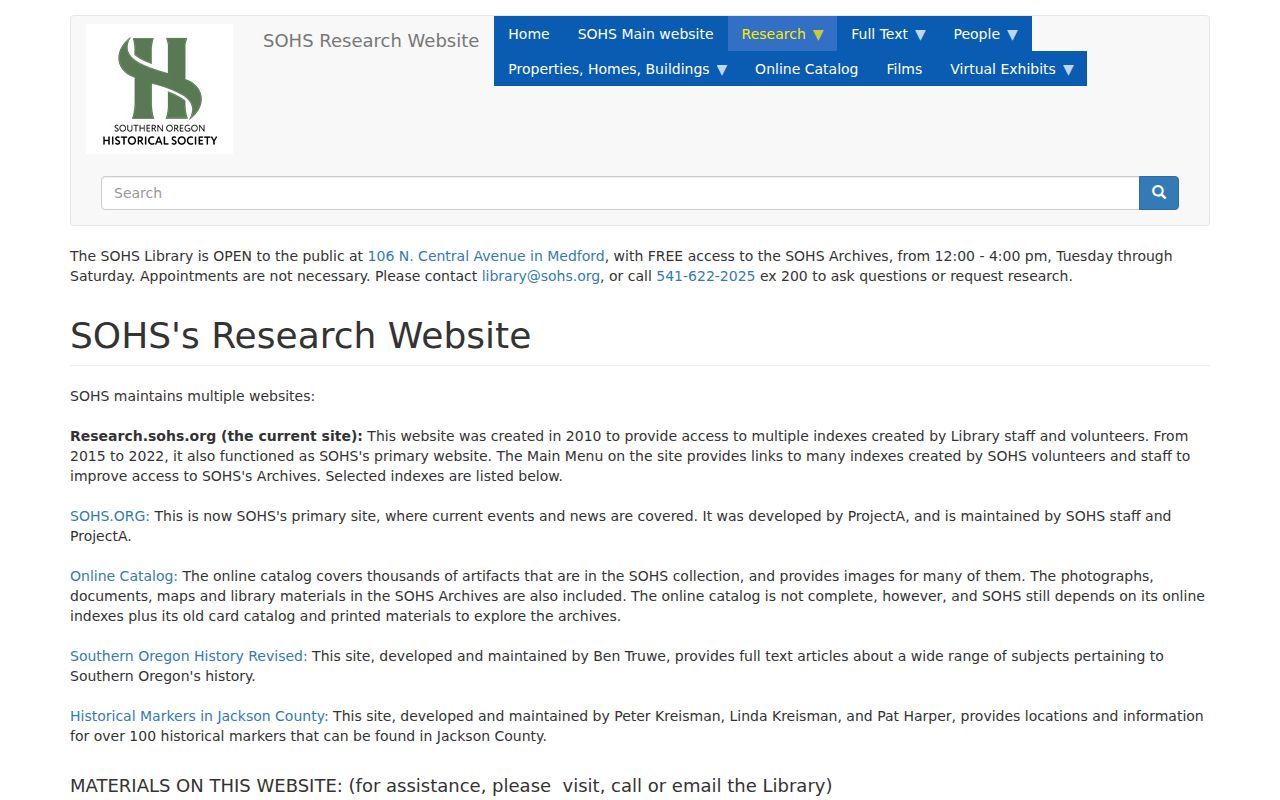
The Southern Oregon Historical Society Research Library is an in-person and email route for items that are not in a digitized directory. It is at 106 N Central Avenue, with free access Tuesday through Saturday from noon to 4 p.m.; no appointment is required. The research desk lists 541-622-2025 extension 200 and library@sohs.org. Its catalog, volunteer-made indexes, and archive counter help turn an incomplete online hit into a collection question.
The SOHS research portal is the access point for that archive and its finding aids.
SOHS indexes can guide the search, but the cited original or scan remains the record to verify.
Rogue Valley Genealogical Society adds another local shelf at 3405 S Pacific Highway, Medford. Its library lists Monday through Saturday, 10 a.m. to 4 p.m., phone 541-512-2340, and reception@rvgslibrary.org. The collection has more than 20,000 volumes, and its obituary index includes 1892 through 1970 material plus selected later clippings. Treat an index result as a lead and verify a death or family detail against the original newspaper, an authorized record, probate, or a published notice.
The RVGS record-search page shows the local genealogy research route.
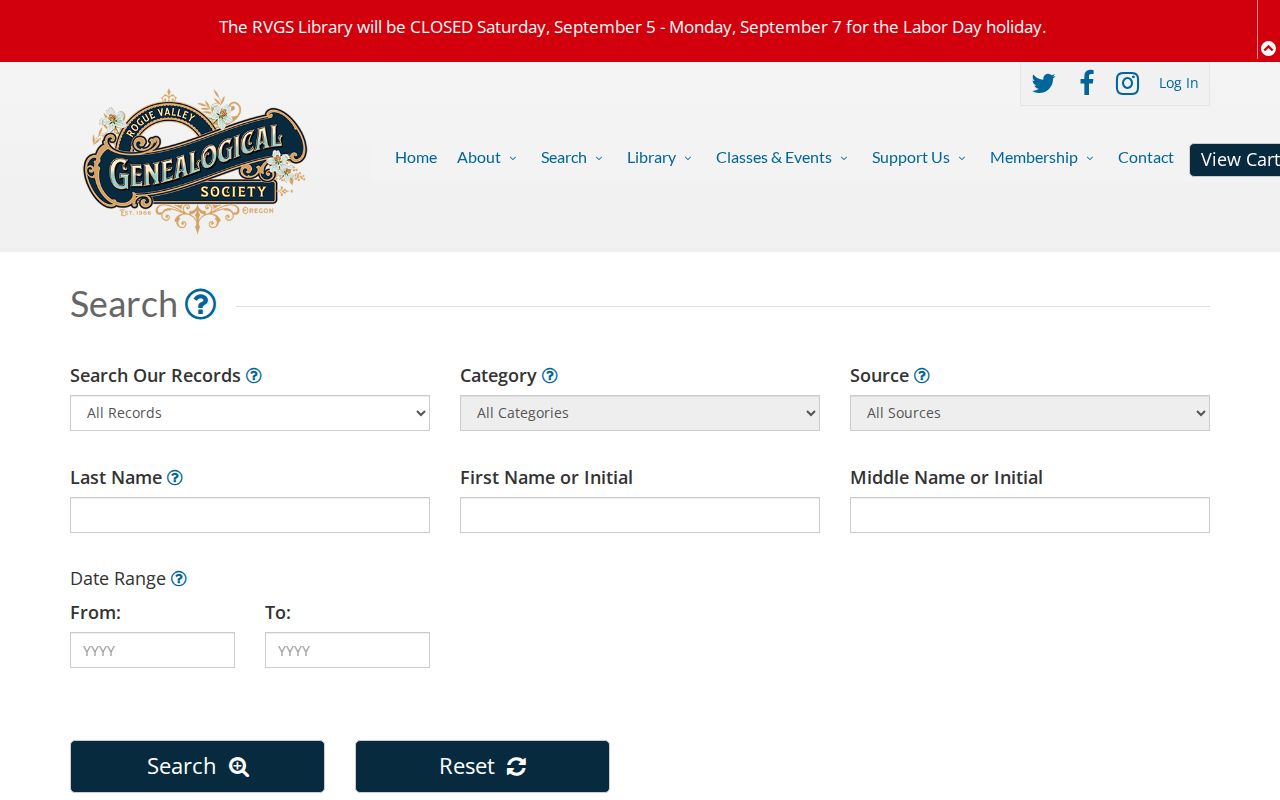
RVGS does not accept wildcard or partial searching, so test complete spelling variants and initials rather than stopping at one failed query.
Trace Medford City Directories by Year
A household trail becomes stronger when each item is treated as dated evidence. Start from the earliest known directory or historical voter-list entry, copy the exact spelling and address, and work in both directions through nearby volumes. Pair the gaps with federal census releases through 1950, then use local newspapers, an obituary index, deeds, or probate material to test a move, death, or name change.
- Capture the year, page, spelling, initials, address, and every abbreviation from a starting city directory entry.
- Read that volume’s key and inspect a scan or original if the transcription omits a mark or context.
- Check earlier and later directory years, retaining possible spelling changes and differences in geographic scope.
- Compare the interval with the available federal census, local newspaper microfilm, and the RVGS obituary-index lead.
- For an address or ownership question, shift to the modern parcel and recording chain on the Medford street directory page rather than treating a directory address as a deed.
A disappearance can mean a move, a changed spelling, a missing volume, a death, or a changed collection scope. It is not one automatic conclusion. Retain the source type and date with each finding so later evidence can confirm or challenge the first reading.
Medford History Between Directory Years
Medford’s local history helps explain why directories and related records can change sharply. The town began with the railroad in 1883 and incorporated in 1885. Orchard-boom growth, the 1910 tent city, and the Camp White influx are documented local transitions that can produce sudden changes in addresses, newspapers, and directory references. They are context, not a reason to assign an event to a named person without a dated source.
| 1883 | Medford began as a railroad town. |
|---|---|
| 1885 | Medford incorporated. |
| 1910 | City history identifies a tent-city episode. |
| Later period | Camp White and postwar growth created another major local records transition. |
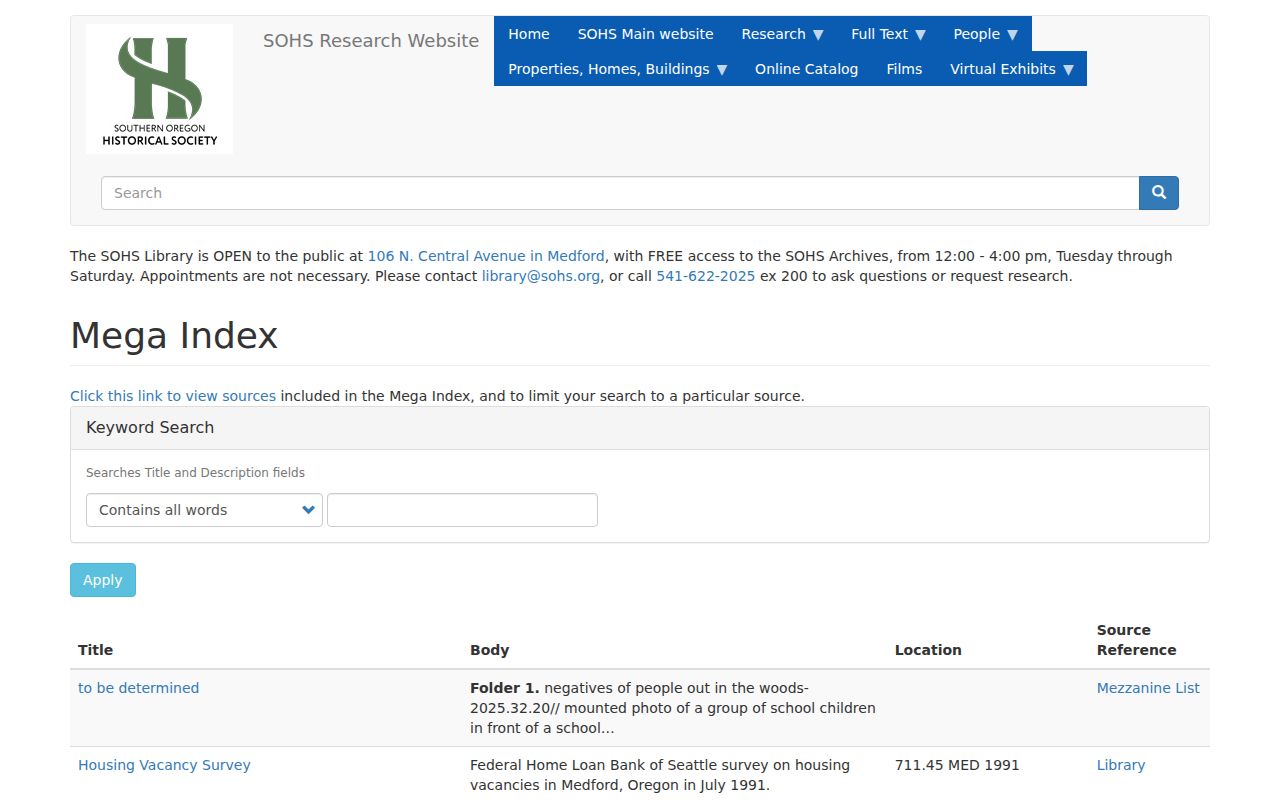
SOHS’s Mega Index covers 56 source groups, including books, maps, scrapbooks, periodicals, vertical files, and Jackson County military lists. It is incomplete, so use it as a finding aid, then locate the item it names. The Oregon Historical Records Index and State Archives custodian guidance add dated estate, naturalization, and other historical leads, subject to the actual record holder’s access rules.
The SOHS Mega Index image shows the local finding-aid route beyond a single directory volume.
Pair a directory entry with an independent dated record before treating it as a family or address conclusion.